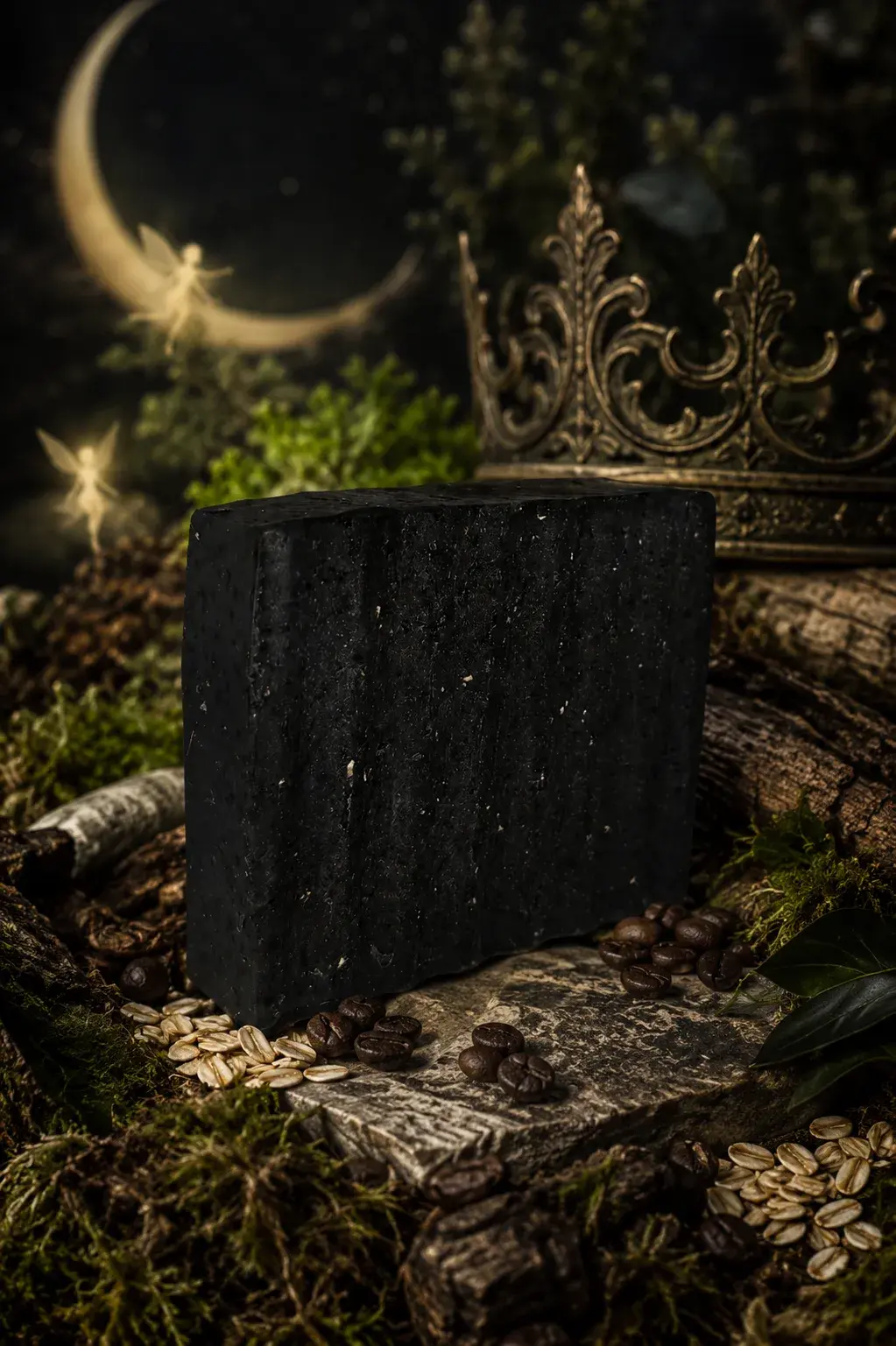
MDB-10
Oberon
Beard Bar
Soap for the beard and the skin beneath it. Cleans the skin most washing never reaches, and leaves the beard soft.
Shipping $6.95–$9.95 · Free over $75 · Shipping & returns
- Best for
- Beards and the skin underneath
- Use on
- Beard and face
- Feels like
- Deep clean, no tightness
- Richness
- Rich
- Superfat
- 9%
- Cure
- 4–6 weeks
Wrapped in NatureFlex, a certified home-compostable cellulose film that breaks down in a home compost bin, not just an industrial facility.
Safety
For external use only. Avoid eyes and mucous membranes. Do not use on broken or irritated skin. Discontinue use if irritation occurs. Review the full ingredient list before use, especially if you have known allergies or sensitivities. Keep out of reach of children and pets.
Scrub Level: this bar contains coarse particulate material. Use light pressure. Do not use on freshly shaved, broken, or irritated skin. Avoid use around the eyes.
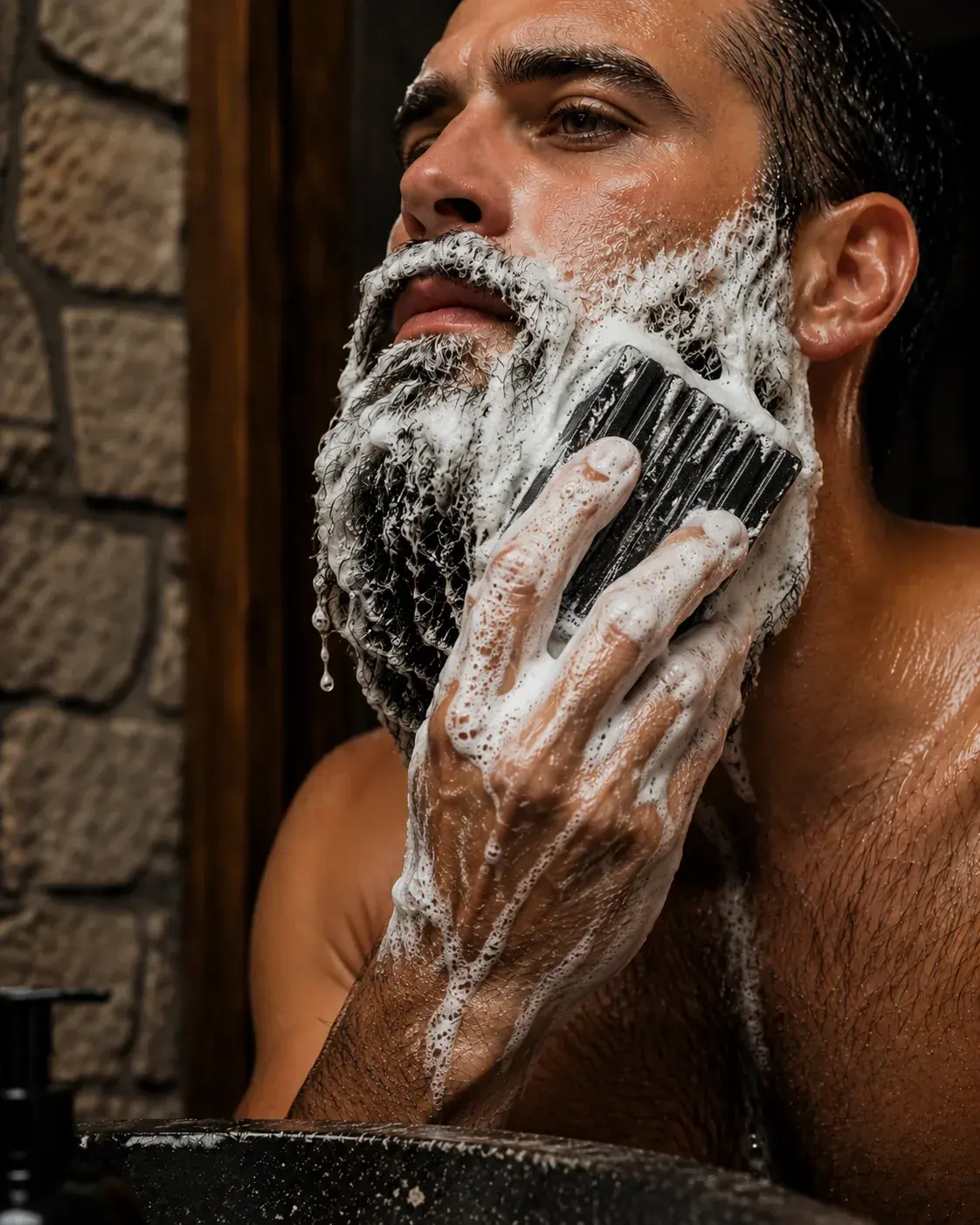
A beard bar has one real job, and most miss it: the hair draws all the attention while the area beneath, where oil and buildup gather, goes ignored. Oberon works through the beard first, then the surface below it.
Activated charcoal helps bind the oil and buildup that settle where a washcloth rarely reaches. Coarse dark-roast coffee brings the grit, the firmest scrub in the range, ground heavy enough to move through dense hair instead of skating over it. Castor helps shape the lather and the finished feel of the bar, while the higher-superfat formula keeps the wash from turning harsh beneath the depth of the clean.
The whole thing traces back to a bar I never meant to sell. I gave my mechanic some of the soap I made for myself, and a few days later his wife sent him back for more, fifty dollars in hand and the sheepish look of a man running his wife's errand. He was giddy about it, said she wanted to kiss him again. Oberon grew out of that, built in earnest once there was a bench to build it on.
Clean through the beard, down to the surface below, and nothing neglected in between.
The ingredients
This bar adds activated charcoal, coarse dark-roast coffee, castor, oats, and a higher-superfat structure for a beard bar that has to work through dense hair instead of skating over it.
Activated charcoal gives Oberon its dark body and deep wash character. Coarse dark-roast coffee brings the grit, ground heavy enough to move through the beard rather than disappear into the lather. Oat material rounds out the bar and keeps it connected to the rest of the Moondog line without softening what the bar is supposed to be.
Castor helps shape the lather and the finished feel of the bar. The higher-superfat formula keeps the wash from turning harsh beneath the depth of the clean.
This is the dark, scrubby beard bar: charcoal, coffee, castor, oats, and no added fragrance hiding the formula.
Full ingredients (INCI)
Sodium Ricebranate, Sodium Cocoate, Sodium Olivate, Sodium Sweet Almondate, Sodium Castorate, Sodium Shea Butterate, Aqua, Oryza Sativa (Rice) Starch Extract, Avena Sativa (Oat) Extract, Coffea Arabica Seed Extract, Camellia Sinensis Leaf Extract, Chamomilla Recutita Flower Extract, Moringa Oleifera Leaf Extract, Capra (Goat) Milk, Mel (Honey), Simmondsia Chinensis (Jojoba) Seed Oil, Sodium Lactate, Rosmarinus Officinalis (Rosemary) Leaf Extract, Stearic Acid
Full ingredients are listed for transparency. Review ingredients before use, especially if you have known allergies or sensitivities.
Sodium hydroxide is the alkali that turns oils into soap. It is fully consumed in the reaction, so none remains in the finished bar.
What is sodium lactate?
The sodium salt of lactic acid, fermented from sugar beets and then neutralized. In cold process it helps the bar set faster and cure harder, and any trace left behind works as a humectant. The FDA classifies it as GRAS. It is the same acid your own skin and muscles already make.
What is stearic acid?
Palm-free, sourced from flax and Mahua (Madhuca longifolia). In the bar it contributes hardness and a stable, lasting lather. Most commercial stearic acid is a palm derivative; closing that gap is part of being palm-free all the way down.
What is rosemary extract (ROE)?
A natural rosemary extract used in a small amount as an antioxidant. It slows the oils from oxidizing so the bar stays fresh longer. It is added for shelf life, not for scent.
The chemistry
This formula is a multiphase cold-process soap composite. The continuous functional phase is a cured sodium fatty-acid salt matrix. Dispersed through that matrix are insoluble carbon, coarse coffee particulate, oat-derived solids, residual lipid from the superfat calculation, retained glycerol, reduced water, and soluble process salts.
The soap phase is generated by alkaline hydrolysis of triglycerides. Sodium hydroxide cleaves ester bonds, liberating glycerol and converting fatty-acid chains into sodium carboxylates. The resulting sodium fatty-acid salts are amphiphilic molecules, with hydrophilic carboxylate heads and hydrophobic hydrocarbon tails. Their collective behavior in water accounts for the basic surfactancy of the bar.
The fatty-acid distribution is chemically mixed. Shorter-chain saturated salts such as sodium laurate and sodium myristate are comparatively soluble and contribute rapid lather. Longer-chain saturated salts such as sodium stearate and sodium palmitate contribute hardness and structure. Unsaturated C18 salts such as sodium oleate and sodium linoleate broaden the softer, less crystalline fraction. Sodium ricinoleate contributes hydroxylated C18 character and modifies foam rheology.
Activated charcoal is not a reactant in saponification. It is an insoluble, largely carbonaceous solid with high internal surface area derived from micro- and mesoporosity. Its role is governed by surface adsorption and physical dispersion, not by conversion into soap. It remains a discrete solid phase within the cured matrix.
Coarse coffee is also a suspended solid phase. It is chemically distinct from brewed coffee, coffee extract, coffee fragrance, or fine coffee powder. Particle size is central: coarse particulate affects the physical behavior of the bar differently from soluble extractive material. Coffee lipids and soluble compounds may partition or react depending on exposure to alkali, but the coarse ground fraction remains primarily a particulate solid.
Oat material contributes polysaccharides, starches, proteins, and insoluble plant structure. These components are not saponified into soap. Their fate is governed by hydration, alkaline exposure, particle size, and mechanical dispersion in the batter. Beta-glucan and starch fractions belong to the carbohydrate phase, not the fatty-acid salt phase.
Superfat is created by lye discount. The sodium hydroxide amount is intentionally insufficient to convert the entire lipid charge into sodium fatty-acid salts. The residual fraction may include unreacted triglycerides, free fatty acids, wax esters where present, and unsaponifiable oil components. In a bar carrying adsorptive carbon and abrasive particulate, that residual lipid fraction is part of the material balance of the composite.
Sodium lactate is a soluble sodium salt added for process control. It affects batter firmness, mold release, crystalline development, water behavior, and final hardness. It is not part of the activated carbon phase and not a product of triglyceride hydrolysis.
The final material is a cured composite of sodium fatty-acid salts, glycerol, reduced water, sodium lactate, calculated residual lipid, activated carbon, coarse coffee particles, oat-derived solids, and oil-borne unsaponifiable fractions.
The stories that connect us
Oberon is the king of the fairies, and his country is the forest after dark. He rules the part of the world that only comes alive once the sun is gone, the moonlight on the leaves, the flowers that open at night, the whole green tangle most people walk past in daylight without ever seeing. Shakespeare put him at the heart of a midsummer wood, quarreling with Titania his queen, and to win the argument he sent his servant Puck to fetch a particular flower. Its juice, brushed onto the eyes of someone sleeping, would make them wake and fall in love with the first living thing they laid eyes on. Oberon was the keeper of that flower, the one who could reach into the space between two people who had stopped looking at each other and put the spark back.
A beard is a forest of its own, a dark tangle that lives on the part of a man that mostly gets ignored, and underneath it is skin that almost never sees light or care. That is Oberon's country exactly, the overlooked place that comes alive when someone finally tends it. The bar took his name because of what it actually did. Before any of this was a company, a bar of my soap went home with a friend, a big man built like a Viking with the beard to match, and he used it in that beard, and it left the thing soft enough that his wife sent him back with money in his hand to fetch more, because it had made him kissable again. That is the fairy king's whole trick, the flower that makes love land again where it had wandered off. Oberon presided over the wood and the moonlight and the quiet enchantment that turns indifference back into wanting, and this bar tends the same forest, the one on a man's face, and works the same small magic.