MDL-07
Lunar Cycle
Body Bar
Best seller
Daily soap for the whole body. Cleans without stripping, conditions without leaving a film, and works on any skin from the most resilient to the most reactive.
Shipping $6.95–$9.95 · Free over $75 · Shipping & returns
- Best for
- Everyday washing, any skin
- Use on
- Whole body
- Feels like
- Clean but never tight
- Richness
- Nourishing
- Superfat
- 7%
- Cure
- 4–6 weeks
Wrapped in NatureFlex, a certified home-compostable cellulose film that breaks down in a home compost bin, not just an industrial facility.
Safety
For external use only. Avoid eyes and mucous membranes. Do not use on broken or irritated skin. Discontinue use if irritation occurs. Review the full ingredient list before use, especially if you have known allergies or sensitivities. Keep out of reach of children and pets.
Everything about a good body bar comes down to balance. It is the soap you reach for most, head to toe, every day, so it has to clean thoroughly without making the habit feel punishing. Lunar Cycle holds that line, not by leaning on any single ingredient but by the proportion struck between all of them.
A daily bar has to live in repetition. The oils are measured against one another so the lather carries the day away without turning the wash harsh or heavy. Coconut gives the bar its clean lift, rice bran carries the body of the formula, castor helps the foam hold, and shea gives the bar weight and structure. The surplus left beyond saponification is kept generous enough to round the wash, but restrained enough that the rinse still finishes clean.
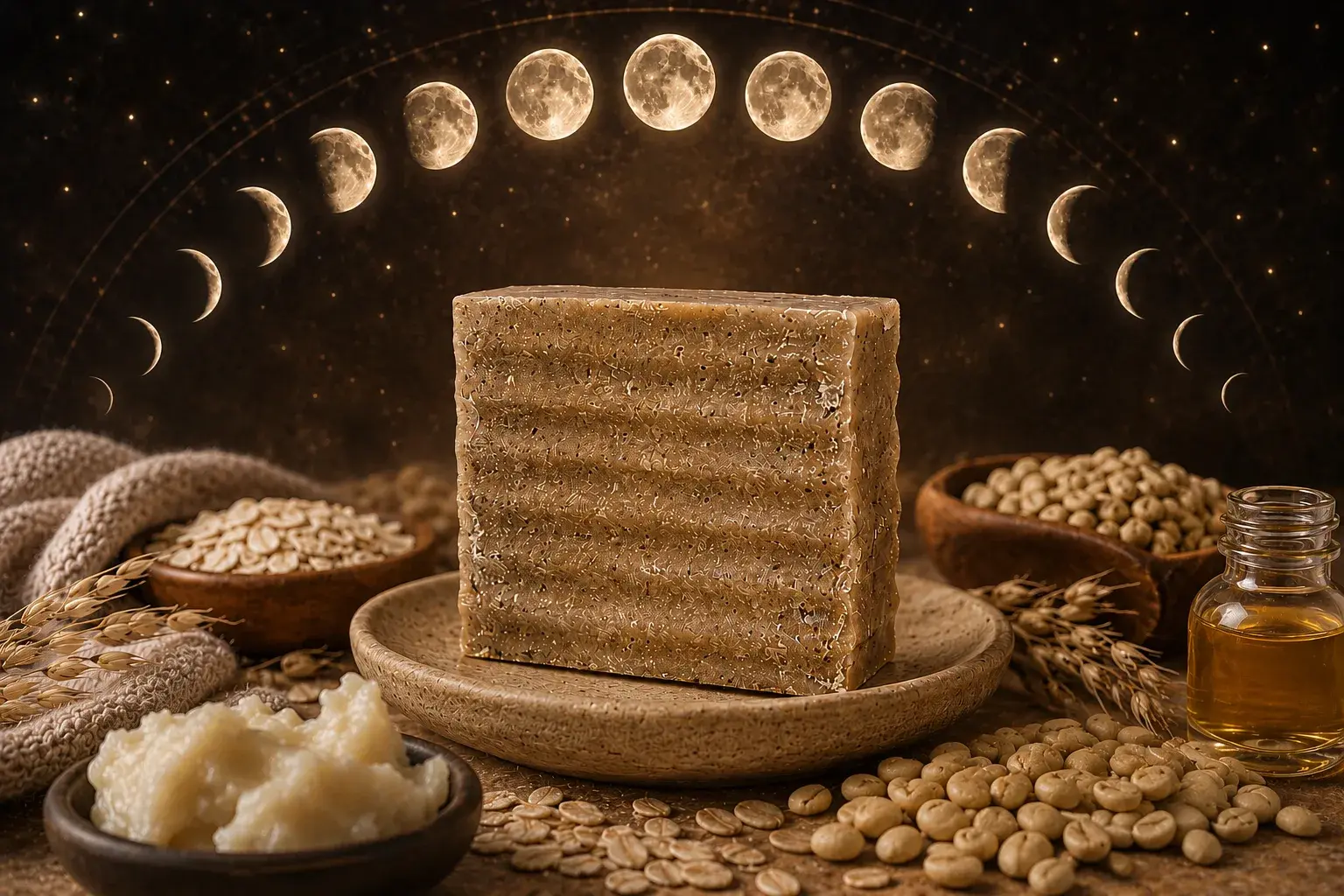
Whole oats are worked through the bar for texture and material character. Fine white coffee lends its pale roast identity and a quiet surface polish, not as fragrance, but as part of the bar itself. The natural glycerin formed in cold process stays in the finished soap rather than being removed and sold off separately. Held in proportion, the parts leave the bar rich without being greasy, clean without feeling sharp, and steady enough for everyday use.
This is the bar the whole line grew from. It began as the soap I made for myself, the daily driver I tuned over years, refined by use until the formula finally felt right. That it came to suit so many people who tried it was never the design, only the result of building one thing carefully enough that it did not need to pretend to be everything.
Clean rinse, soft finish, steady daily use, and the bar that started Moondog.
The ingredients
Lunar Cycle is built around balance: whole oats, fine white coffee, cold-process glycerin, and the oil proportions that made this the original Moondog body bar.
Whole oats are worked through the bar for texture and material character. Fine white coffee gives the bar its pale roast identity and quiet surface polish, not as fragrance, but as part of the soap itself. The natural glycerin formed in cold process stays in the finished bar rather than being removed and sold off separately.
This is the bar the line grew from. It began as the soap I made for myself, the daily driver I tuned over years, refined by use until the formula finally felt right. Oats, white coffee, glycerin, and proportion are the point.
Clean rinse, soft finish, steady daily use, and the bar that started Moondog.
Full ingredients (INCI)
Sodium Ricebranate, Sodium Cocoate, Sodium Olivate, Sodium Sweet Almondate, Sodium Castorate, Sodium Shea Butterate, Aqua, Oryza Sativa (Rice) Starch Extract, Avena Sativa (Oat) Extract, Coffea Arabica Seed Extract, Camellia Sinensis Leaf Extract, Chamomilla Recutita Flower Extract, Moringa Oleifera Leaf Extract, Capra (Goat) Milk, Mel (Honey), Simmondsia Chinensis (Jojoba) Seed Oil, Sodium Lactate, Rosmarinus Officinalis (Rosemary) Leaf Extract, Stearic Acid
Full ingredients are listed for transparency. Review ingredients before use, especially if you have known allergies or sensitivities.
Sodium hydroxide is the alkali that turns oils into soap. It is fully consumed in the reaction, so none remains in the finished bar.
What is sodium lactate?
The sodium salt of lactic acid, fermented from sugar beets and then neutralized. In cold process it helps the bar set faster and cure harder, and any trace left behind works as a humectant. The FDA classifies it as GRAS. It is the same acid your own skin and muscles already make.
What is stearic acid?
Palm-free, sourced from flax and Mahua (Madhuca longifolia). In the bar it contributes hardness and a stable, lasting lather. Most commercial stearic acid is a palm derivative; closing that gap is part of being palm-free all the way down.
What is rosemary extract (ROE)?
A natural rosemary extract used in a small amount as an antioxidant. It slows the oils from oxidizing so the bar stays fresh longer. It is added for shelf life, not for scent.
The chemistry
This bar is a whole-oil cold-process soap whose chemistry is determined by triglyceride hydrolysis, fatty-acid salt distribution, retained glycerol, residual lipid, water loss, and the incorporation of white coffee and oat materials into the cured matrix.
The primary reaction is saponification by sodium hydroxide. Hydroxide cleaves triglyceride ester bonds, producing glycerol and fatty-acid carboxylates. In the presence of sodium ions, those carboxylates exist as sodium fatty-acid salts. The bar is therefore a mixed carboxylate system generated from the fatty-acid profile of the oils, not a compounded synthetic detergent blend.
The physical properties of the soap phase follow the fatty-acid profile. Lauric and myristic acid salts are more soluble and contribute strong early lather. Oleic and linoleic acid salts form a broader unsaturated C18 fraction. Ricinoleic acid, because of its hydroxyl group, contributes a more polar fatty-acid salt and modifies foam texture. Stearic and palmitic acid salts increase crystalline structure, hardness, and body.
Rice bran oil contributes oleic and linoleic triglycerides along with an unsaponifiable fraction containing phytosterols, tocopherols, triterpene alcohol esters, and gamma-oryzanol compounds. Coconut oil supplies the shorter-chain saturated fraction. Olive and sweet almond oils broaden the unsaturated triglyceride portion. Castor oil supplies ricinoleic acid. Shea butter contributes a higher proportion of stearic and palmitic material.
Superfat is a stoichiometric feature of the formula. The lye amount is set below the full saponification value, leaving residual non-soap lipid in the finished bar. That residual fraction is not identical to the original oil blend; it is whatever remains unconverted or partially modified after alkaline processing, including unreacted triglyceride, free fatty acid, and minor unsaponifiable compounds.
White coffee introduces coffee-derived solids and extractives into the alkaline soap system. Insoluble material remains physically suspended. Soluble material partitions into the aqueous phase. Alkali-sensitive constituents may degrade or transform. The correct chemical description is inclusion and processing of white coffee material, not unqualified survival of all native coffee chemistry.
Oat material introduces starches, beta-glucan-containing polysaccharide fractions, proteins, minerals, and insoluble plant solids. These components do not become soap. They remain as suspended, hydrated, extracted, or chemically modified fractions depending on preparation and pH exposure.
Glycerol remains in the bar as a reaction product of triglyceride hydrolysis. Cure reduces water content, increases hardness, changes dissolution behavior, and allows the soap matrix to become more physically organized. Sodium lactate, where used, further modifies firmness, water behavior, unmolding, and cured hardness.
The final bar is a cured heterogeneous matrix of sodium fatty-acid salts, glycerol, reduced water, calculated residual lipid, white coffee material, oat material, sodium lactate where used, and oil-borne unsaponifiables.
The stories that connect us
Before there were clocks, before there were calendars, before there was writing at all, there was the moon. It was the first thing humans ever used to keep time, marked on carved bone more than thirty thousand years ago, long before the first city was built or the first word was written down. People watched it swell and thin and vanish and return, a little under thirty days from one dark sky to the next, and they planted by it, harvested by it, and counted their lives in its turns. The very word month is just an old word for moon worn smooth by use. For nearly the whole of human history, the moon was the rhythm everyone lived inside.
We keep our time by other things now, but the body still runs on cycles, and the oldest of them is the plain daily one, the small round of waking and washing and going out into the day. This is the bar built for that turn, the one you reach for every morning as the moon outside moves through a cycle of its own, roughly one full set of phases to one bar worn down to nothing. It started as the soap I made for myself, the daily-driver I tuned over years to my own skin, and it settled at last into something gentle enough to use every single day without paying for it. That it ended up suiting nearly everyone who tried it was never the plan. It was only proof that a thing made carefully enough for one person, repeated patiently enough, can come to fit almost anyone, the way the oldest rhythm in the sky still keeps time for all of us whether we are watching it or not.