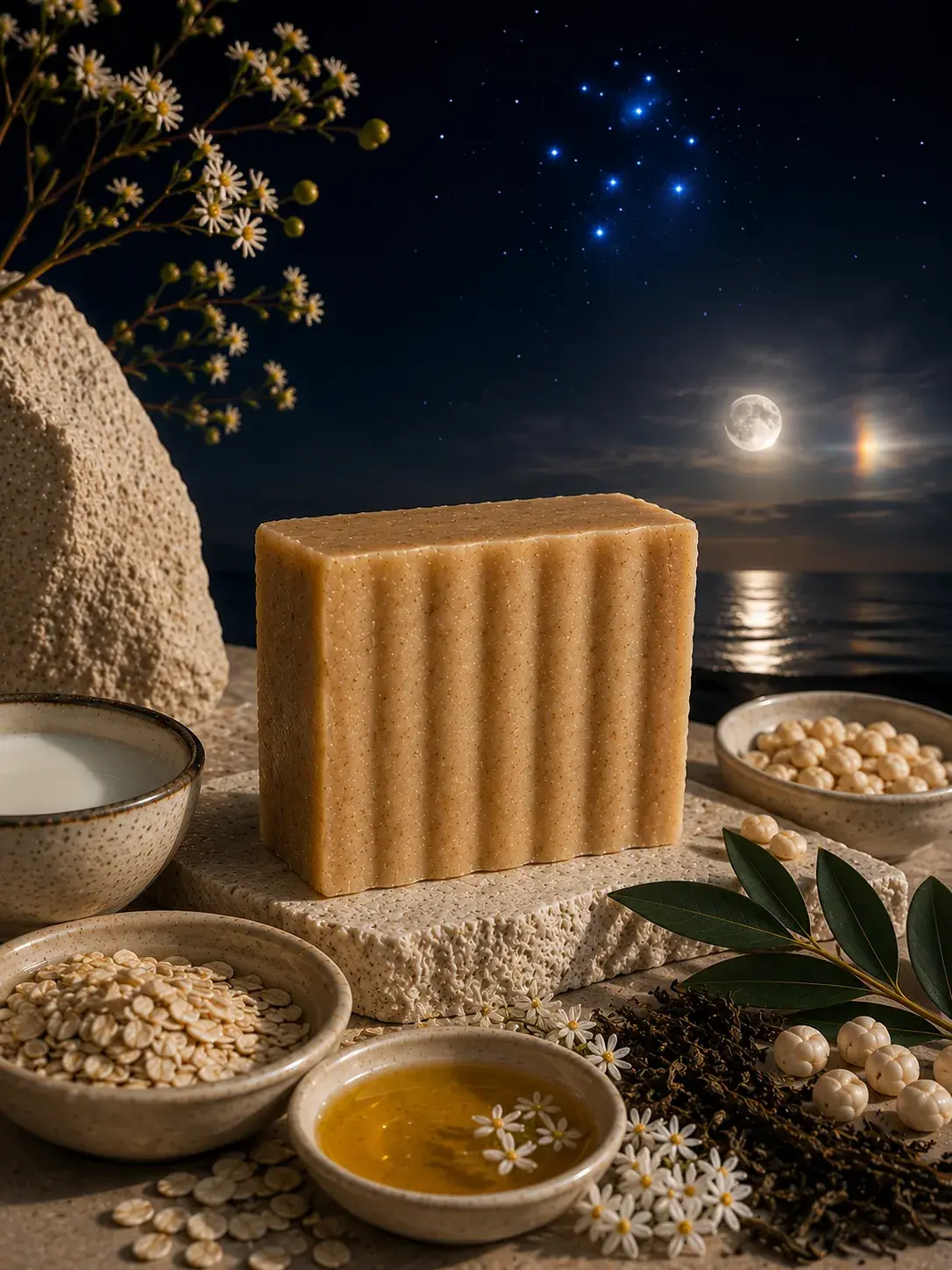
MDF-10
Call of the Pleiades
Facial Bar
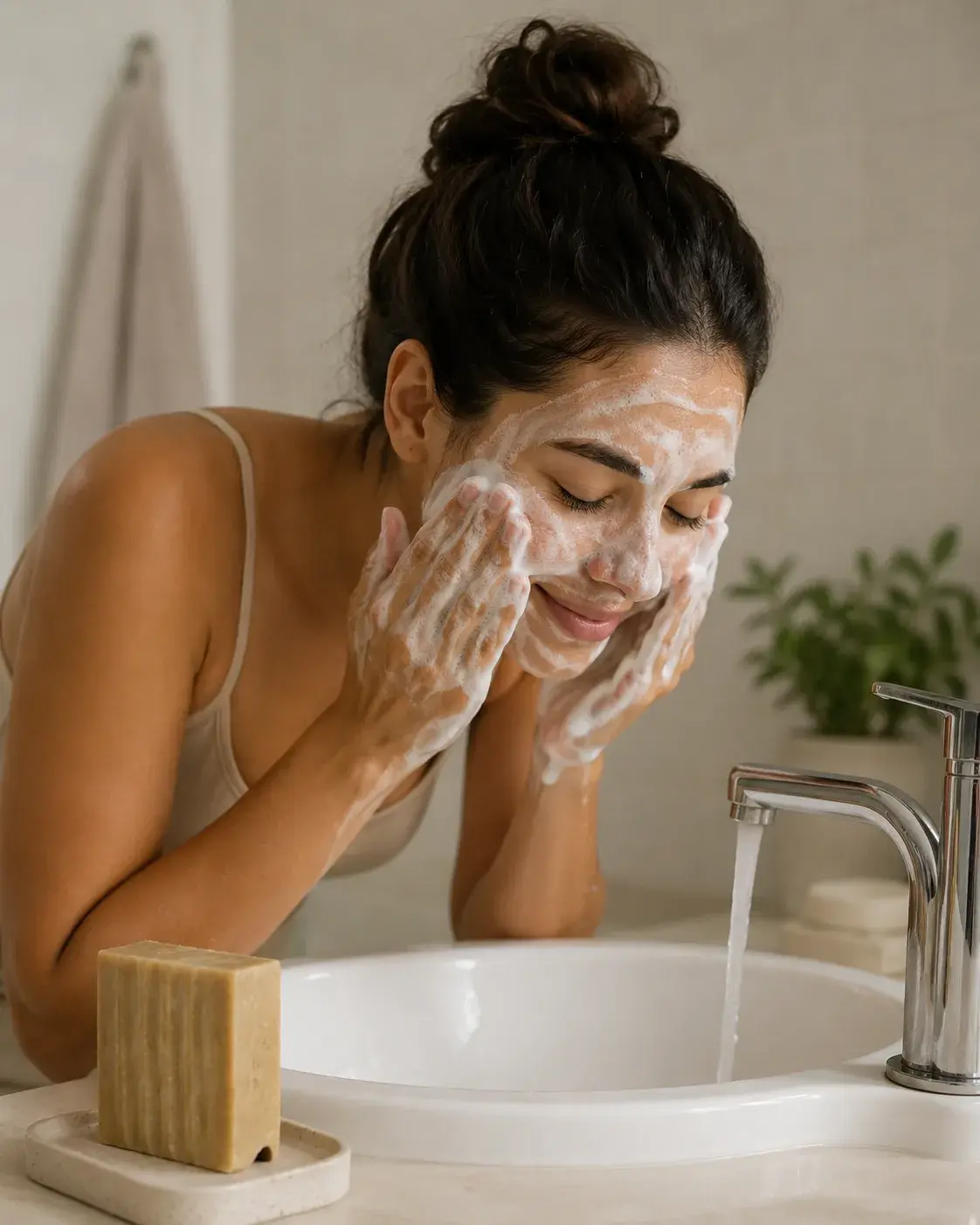
The conditioning of a face oil. The clean of a true wash. In a single bar that leaves nothing heavy behind.
Shipping $6.95–$9.95 · Free over $75 · Shipping & returns
- Best for
- Dry or easily irritated skin that hates being stripped
- Use on
- Face
- Feels like
- Rich and cushioning
- Richness
- Rich
- Superfat
- 9%
- Cure
- 4–6 weeks
Wrapped in NatureFlex, a certified home-compostable cellulose film that breaks down in a home compost bin, not just an industrial facility.
Safety
For external use only. Avoid eyes and mucous membranes. Do not use on broken or irritated skin. Discontinue use if irritation occurs. Review the full ingredient list before use, especially if you have known allergies or sensitivities. Keep out of reach of children and pets.
A facial bar has to make a hard bargain: clean thoroughly without making the rinse feel punishing. Call of the Pleiades is built for that narrow line. Its lather is drawn from saponified plant oils rather than a synthetic detergent system, and a deliberate surplus of those oils remains outside the soap phase in the cured bar, so the wash that lifts away makeup, sunscreen, and the day's residue finishes rich instead of sharp. Coconut supplies a clean, generous lather; rice bran, the oil the formula is built around, carries an unsaponifiable fraction that gives the finished bar more than a simple fatty-acid profile.
Jojoba is what reconciles the bar's richness with a lighter finish. Alone among the oils here, it is not a triglyceride but a wax ester, structurally distinct from the saponifying oil base and carried differently in a higher-superfat formula. Around that center, colloidal oatmeal softens the bar's texture, the natural glycerin that larger manufacturers extract and resell stays where it belongs inside the finished soap, and a fine grind of white coffee lends a light, quiet polish.
Rich enough for the face. Restrained enough for daily use.
The ingredients
This bar is built around rice bran, jojoba, colloidal oatmeal, green tea, and fine white coffee. Rice bran carries the formula's main oil body and its unsaponifiable fraction. Jojoba belongs here because it is not a triglyceride oil at all, but a liquid wax ester, which makes it a different kind of material inside a richer facial bar.
Colloidal oatmeal gives the bar a soft, creamy texture. Green tea brings the pale botanical note. Fine white coffee adds a light polish and ties the bar back to Moondog's white-coffee identity without turning it into coffee perfume or novelty soap.
The result is the richest facial bar in the line: high-superfat, unscented, fragrance-free, and built around materials chosen for a softer, more finished wash.
Full ingredients (INCI)
Sodium Ricebranate, Sodium Cocoate, Sodium Olivate, Sodium Sweet Almondate, Sodium Castorate, Sodium Shea Butterate, Aqua, Oryza Sativa (Rice) Starch Extract, Avena Sativa (Oat) Extract, Coffea Arabica Seed Extract, Camellia Sinensis Leaf Extract, Chamomilla Recutita Flower Extract, Moringa Oleifera Leaf Extract, Capra (Goat) Milk, Mel (Honey), Simmondsia Chinensis (Jojoba) Seed Oil, Sodium Lactate, Rosmarinus Officinalis (Rosemary) Leaf Extract, Stearic Acid
Full ingredients are listed for transparency. Review ingredients before use, especially if you have known allergies or sensitivities.
Sodium hydroxide is the alkali that turns oils into soap. It is fully consumed in the reaction, so none remains in the finished bar.
What is sodium lactate?
The sodium salt of lactic acid, fermented from sugar beets and then neutralized. In cold process it helps the bar set faster and cure harder, and any trace left behind works as a humectant. The FDA classifies it as GRAS. It is the same acid your own skin and muscles already make.
What is stearic acid?
Palm-free, sourced from flax and Mahua (Madhuca longifolia). In the bar it contributes hardness and a stable, lasting lather. Most commercial stearic acid is a palm derivative; closing that gap is part of being palm-free all the way down.
What is rosemary extract (ROE)?
A natural rosemary extract used in a small amount as an antioxidant. It slows the oils from oxidizing so the bar stays fresh longer. It is added for shelf life, not for scent.
The chemistry
The formulation problem is not cleansing in the abstract, but the construction of a high-superfat sodium soap whose detergency is moderated by fatty-acid distribution, retained glycerol, unsaponifiable material, and a controlled non-soap lipid fraction. The finished bar is not an oil blend and it is not a synthetic detergent system. It is a cured, heterogeneous matrix of sodium fatty acid salts, glycerol, reduced water, residual lipid, sodium lactate, wax esters where present, and dispersed botanical material.
The principal reaction is alkaline ester hydrolysis. Sodium hydroxide cleaves triglyceride ester linkages and converts the liberated fatty acids into their sodium carboxylate salts. The glycerol backbone remains as glycerol rather than being removed as in some industrial soapmaking streams. Free fatty acids already present in the oils are neutralized directly to sodium salts. The resulting soap phase is a mixed carboxylate system, not a single surfactant species.
The fatty-acid distribution is the controlling architecture. Rice bran oil contributes a predominantly oleic/linoleic triglyceride profile and a minor unsaponifiable fraction. Coconut oil supplies lauric and myristic acids, whose sodium salts have higher aqueous solubility and stronger lathering behavior than long-chain saturated salts. Olive and sweet almond oils extend the unsaturated C18 fraction. Castor oil contributes ricinoleic acid, 12-hydroxy-9-cis-octadecenoic acid; the hydroxyl group increases polarity and gives sodium ricinoleate its distinctive effect on foam body and persistence. Shea butter contributes stearic and palmitic fractions, whose sodium salts are less soluble and more structural, increasing hardness and body.
The superfat is a stoichiometric decision. The sodium hydroxide charge is calculated below the full saponification value, leaving a residual non-soap lipid fraction after conversion. That fraction may include unsaponified triglycerides, free fatty acids, wax esters, and oil-borne unsaponifiables, depending on the chemistry and SAP behavior of each input. It should not be described as raw oil simply surviving intact; it is the unconverted and partially process-altered residue of a deliberately lye-discounted system.
Jojoba is chemically distinct from the triglyceride oils. It is composed primarily of long-chain wax monoesters rather than glycerol triesters, so it does not enter the saponification calculation in the same way as rice bran, coconut, olive, almond, castor, or shea. In a higher-superfat soap, its most relevant chemical identity is as a wax-ester component of the residual lipid phase.
Rice bran's unsaponifiable fraction includes gamma-oryzanol, a mixture of ferulic acid esters of phytosterols and triterpene alcohols. These compounds are not triglycerides and are not represented by the normal fatty-acid SAP profile. That does not mean every native minor compound passes through high pH unchanged; alkaline hydrolysis can affect esterified phenolics and other labile structures. The precise claim is narrower: the rice bran input contributes a non-glyceride fraction to the cured matrix, distinct from the fatty acids converted into sodium soap.
White coffee, oat, and green tea materials enter as plant-derived solids or extractive fractions, depending on preparation. Insoluble particles remain physically dispersed. Water-soluble fractions partition into the aqueous phase before cure. Alkali-labile compounds may hydrolyze, oxidize, or otherwise degrade. The chemically accurate description is not preservation of raw botanical activity, but incorporation of processed plant material into a high-pH soap matrix.
Sodium lactate is an added sodium carboxylate salt. It is not produced by the triglyceride saponification reaction. In the soap batter it affects ionic strength, water behavior, crystallization, firmness, mold release, and final hardness. In the cured bar it remains part of the soluble salt fraction distributed through the soap matrix.
The finished composition is therefore best described as a cured mixed sodium carboxylate system with retained glycerol, reduced water, lye-discount residual lipid, jojoba wax esters, rice bran unsaponifiables, sodium lactate, and processed white coffee, oat, and green tea material.
The stories that connect us
Almost everyone grows up with the Greek Pleiades, the seven sisters set among the stars. We tell the older story for this land instead, the one the Niitsitapi (the Blackfoot, the original people of these plains) have kept.
In their tradition the cluster is a group of orphans, the Lost Boys, children no one in the camp would care for. They were left to go without while the people looked after their own, and the only ones who looked after the boys at all were the makoyi (the wolves), who took them in as the rest would not. Their neglect did not go unseen. Natosi (the Sun) grew angry that the people had abandoned their own children, and sent a drought down onto the camp, and the land dried and the iinii (the buffalo) vanished from it, and the people who had withheld their care were left with nothing to eat. It was the makoyi (the wolves) who answered even then, moving to bring the iinii (the buffalo) back to a people who had earned no such kindness. The boys, worn down by a life on earth that had never made room for them, asked Natosi (the Sun) to lift them into the heavens where they could be out of reach of all of it, and there they remain, gathered close in the night sky.
The makoyi (the wolves) could not climb up after them. They stayed below on the dry ground and howled toward the boys they had lost, and that cry, carrying night after night, was meant to keep the people in mind of the children they had failed. That howl is where Moondog takes its name, the sound of the one who stays behind and keeps calling after what everyone else was willing to lose.
The land in that story cracks and goes hungry for want of care, which is the same thing skin does when an industry strips it and sells back what it took. The Pleiades hangs as a cluster of seven, and seven oils sit beneath the name on this bar, rice bran and coconut, olive and sweet almond, castor, shea, and jojoba, each carrying part of the work. It was built to do what the makoyi did: look after the part of you that was left to go without.